Guide
What Is a Restaurant Commerce Platform?
Discover the unified restaurant commerce platform that brings ordering, payments, operations, customers and sales into one infrastructure.
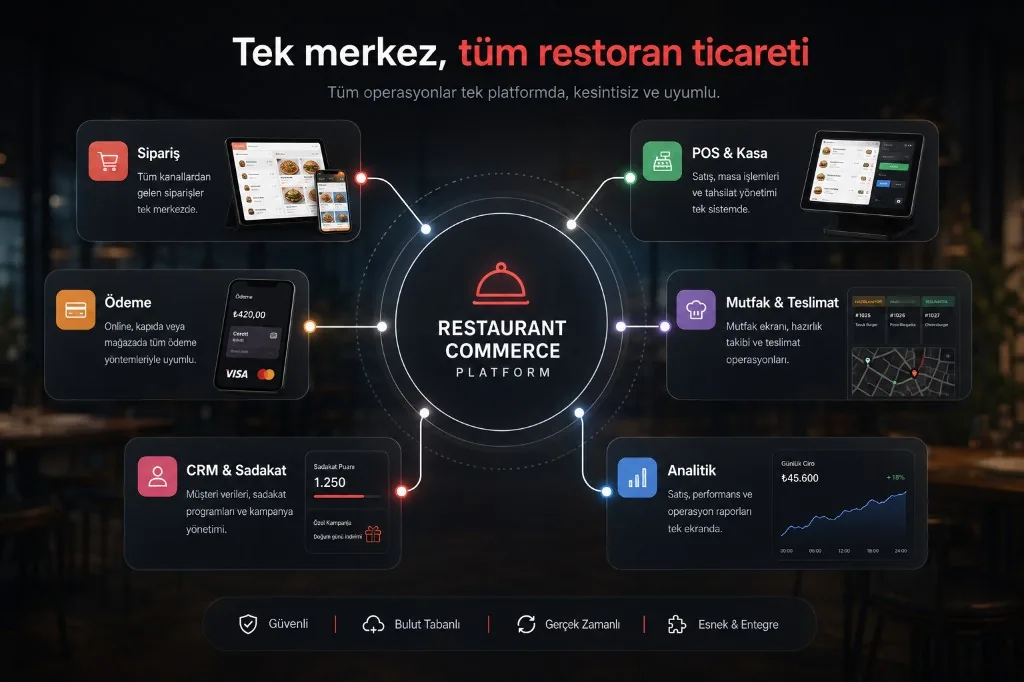
Why a “Commerce Platform”?
Not Just Taking Orders — Managing the Full Sales Cycle
An order is not finished when a customer builds a cart.
Customer orders → payment completes → kitchen prepares → delivery happens → the transaction is recorded → the customer can order again.
A Restaurant Commerce Platform treats these steps as one commerce flow instead of disconnected systems.
- Customer
- Order
- Payment
- Kitchen
- Delivery
- Customer Data
- Repeat Sales
Platform structure
A Restaurant’s Digital Commerce Infrastructure
Five core layers form the end-to-end skeleton of restaurant commerce.
One shared data model
Every Transaction Is Part of the Same Data
The key difference of a Restaurant Commerce Platform is that processes do not stay as isolated records.
Product, customer, order and payment data stay connected — so the same source can power ordering, operations, history and reporting.
Order → Operations → Reporting → Repeat Sales
Separate tools vs platform
Connected Systems Instead of Scattered Tools
Separate tools
- Online Ordering
- POS
- Payments
- CRM
- Loyalty
- Reporting
Platform approach
Ordering · POS · Payments · CRM · Loyalty · Analytics
One data model, shared infrastructurePut your own channel at the center
Your Ordering Channel Sits at the Center of the Platform
A Restaurant Commerce Platform is not only for aggregating marketplaces — it strengthens the business’s own sales channel.
Customers order through your branded web, mobile or QR Menu experience; the customer and order relationship lives in your infrastructure.
Scalable structure
From a Single Branch to Multi-Branch
A Restaurant Commerce Platform can be designed not only for today’s needs, but for growth.
-
Single Branch
Online ordering and QR Menu
-
Growing Business
POS · payments · customer management
-
Multi-Branch
Central management · branch performance
→ -
Franchise
Brand and operations standardization
→
As the business grows, you can expand the same infrastructure instead of switching systems.
What the platform contributes
The Difference an Integrated Stack Makes
One Data Model
Sales and customer data do not scatter across tools.
Less System Chaos
Fewer brittle connections between separate apps.
Your Own Channel
Your branded direct-order channel stays central.
Scalable Structure
Grows from one branch to a multi-branch operation.
Choosing a platform
What Should You Look For?
Five core questions instead of a long feature list:
- Do ordering and operations work together?
- Does it offer a branded ordering channel?
- Can it integrate with POS, payments and other systems?
- Can it keep customer and sales data in one structure?
- Can it scale from one branch to many?
Related pages
Bring Your Restaurant Commerce Stack Into One System
Build your digital restaurant commerce infrastructure under your own brand — from online ordering to operations, CRM to reporting.